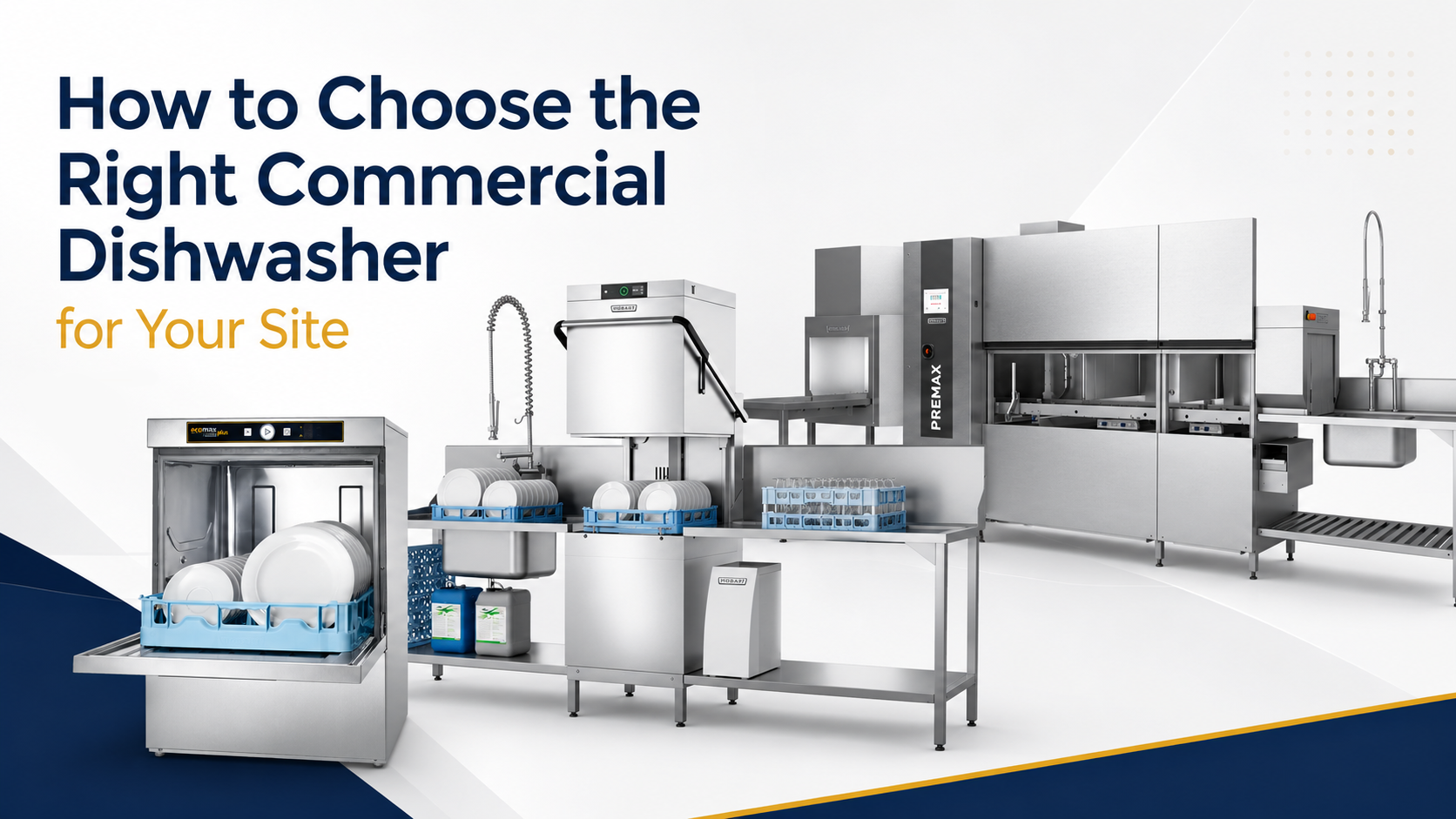
How to Choose the Right Commercial Dishwasher for Your Site
The right commercial dishwasher is one your team can rely on through the busiest service of the year without a second thought. The wrong one can mean bottlenecks, call-outs, and dishes that never quite look clean. Getting the decision right the first time saves money, time, and operational headaches for years to come.
This guide covers every factor that matters when choosing a commercial dishwasher for a professional kitchen, from understanding your daily throughput to selecting the right machine type, water treatment, and range specification. The Hobart warewashing range is used throughout as the reference point, with all three range tiers explained in plain terms.
Start With Your Throughput
Throughput is the single most important factor in commercial dishwasher selection. A machine that cannot keep pace with your busiest service period will become a bottleneck no matter how well-specified it is in every other regard.
Throughput is measured in racks per hour. A rack is a standard basket of crockery, typically 500x500mm in size. Before looking at any machine, calculate how many racks your site needs to process per hour at peak.
A practical way to estimate this is to count the number of covers you serve during your busiest sitting, factor in the number of items per cover, and divide by the number of minutes available for washing. Most operations underestimate their peak demand, so build in a buffer of at least 20% above your calculated figure.
As a rough guide, a site serving up to 80 covers per sitting can typically be served by a capable undercounter dishwasher. Sites serving 80 to 200 covers will generally require a pass-through dishwasher. Above 200 covers, or for continuous high-volume operations such as schools, hospitals and contract catering, a rack conveyor or flight-type machine should be considered.
These are starting points, not fixed rules. The nature of your service, the complexity of the wash load, and whether your operation runs continuously throughout the day all affect the right answer for your site.
Undercounter Dishwashers
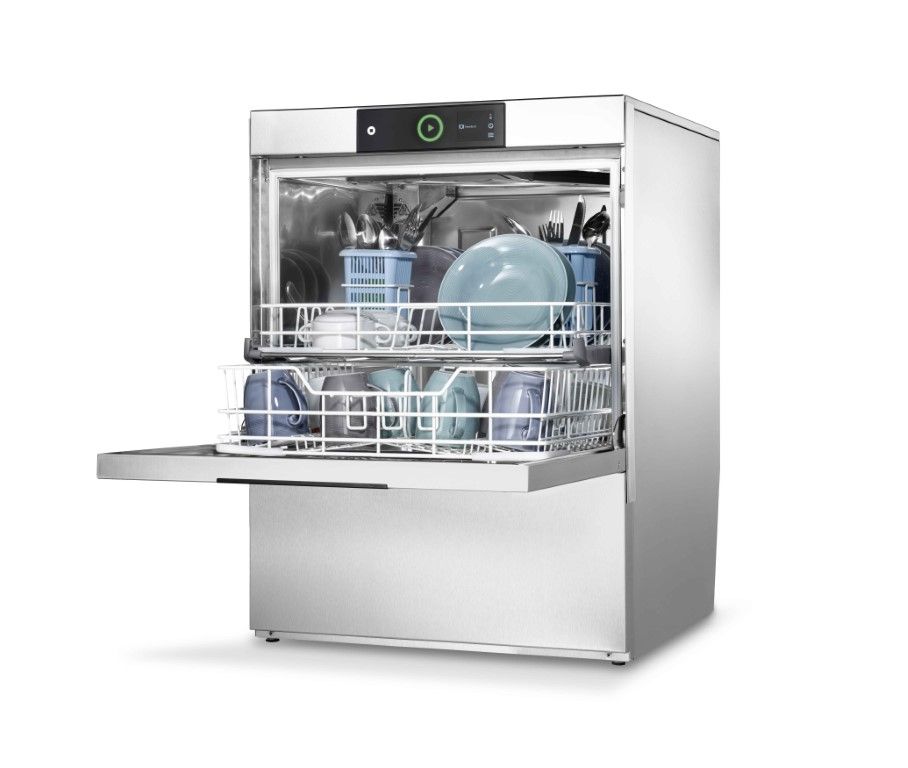
Undercounter dishwashers are front-loading machines designed to sit beneath a standard commercial kitchen worktop. They are the most common choice for smaller and medium-volume sites including cafes, pubs, small restaurants, staff canteens, and office kitchens.
A standard undercounter dishwasher washes a 500x500mm rack per cycle, with cycle times typically ranging from 60 to 180 seconds depending on the programme selected. They are straightforward to install, compact in footprint, and cost-effective to run.
The trade-off against larger machine types is throughput. An undercounter dishwasher is loaded and unloaded one rack at a time by an operator, which limits the sustained output even at short cycle times. For sites with continuous or very high-volume demand, an undercounter machine will not keep pace regardless of the specification.
Pass-Through Dishwashers
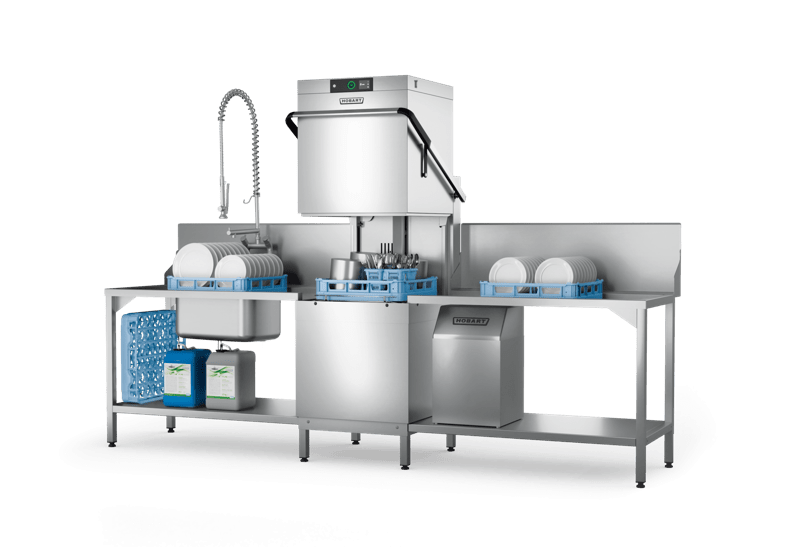
Pass-through dishwashers are hood-type machines where a rack of crockery is loaded at counter height, the hood is lowered over it, and the washed rack exits from the opposite side onto an outlet table. This continuous flow approach means the machine can keep pace with service in a way that a front-loading undercounter cannot.
Pass-through machines are the right choice for medium to high-volume sites where throughput is the primary concern, including busy restaurants, hotel kitchens, school dining rooms, and large care home operations. They require inlet and outlet tabling and a dedicated wash area with adequate ceiling height to accommodate the raised hood.
Throughput on a pass-through machine typically ranges from around 45 racks per hour on a standard Ecomax configuration up to 70 or more racks per hour on higher-specification Profi and Premax models.
Rack Conveyor and Flight-Type Dishwashers
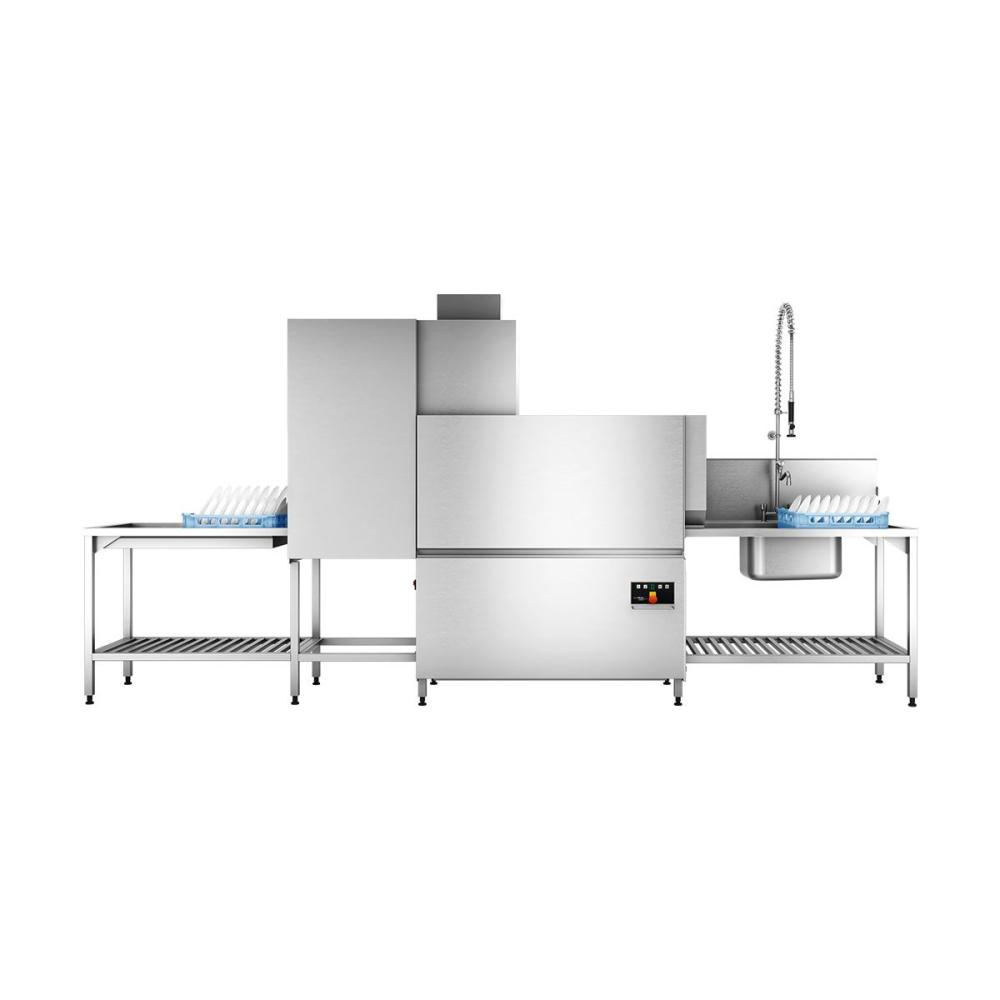
Rack conveyor and flight-type dishwashers are designed for high-volume continuous operations. In a conveyor machine, loaded racks pass automatically through the wash zones on a motorised conveyor belt, with no manual hood operation between cycles. Flight-type machines go further still, washing items on a continuous belt sometimes without the need for individual racks.
These machines are the right solution for large-scale contract catering, hospital and healthcare facilities, stadium and events catering, and any operation where the volume of washing is continuous throughout the day. They require a dedicated wash area with significant space, and three-phase power is standard.
Undercounter or Pass-Through: The Key Decision
For the majority of buyers, the most important choice is between an undercounter and a pass-through dishwasher. Understanding where the boundary lies helps avoid both overspending on capacity you do not need and under sizing a machine that cannot cope.
Choose an undercounter dishwasher if:
- Your operation serves up to around 80 covers per sitting
- Your wash load is relatively consistent and not concentrated into short peaks
- Space or budget constraints make a pass-through impractical
- You need a machine for a secondary wash area, back bar, or staff kitchen
- Your site does not have the ceiling height or floor space for inlet and outlet tabling
Choose a pass-through dishwasher if:
- Your operation consistently serves more than 80 covers per sitting
- You run multiple sittings or continuous service with little recovery time between covers
- Your wash load includes a high proportion of large or awkward items
- Staff throughput efficiency is a priority and you need a hands-free wash flow
- You are running a school, care home, hotel, or other institution with sustained daily demand
If you are on the boundary between machine types, always size up rather than down. A pass-through machine in a kitchen that could have managed with a large undercounter will run quietly and efficiently for years. An undercounter machine in a kitchen that needed a pass-through will struggle from day one.
Water Hardness and Water Treatment
Water hardness is one of the most overlooked factors in commercial dishwasher selection and one of the most damaging when it is ignored. Around 60 per cent of the UK is supplied with hard or very hard water. In hard water areas, limescale deposits accumulate inside the machine on heating elements, wash arms, and internal pipework. Left untreated, this reduces performance, increases energy consumption, shortens machine life, and leaves visible watermarks on glassware and crockery.
The solution is a water softener, either built into the machine as an integrated unit or installed externally as a standalone softener serving the machine.
Integrated Water Softeners
Many Hobart dishwashers are available with an integrated water softener as a factory-fitted option. This is typically denoted by an S suffix in the model’s name. An integrated softener is the most convenient option for undercounter and pass-through dishwashers, requiring only the addition of softener salt rather than a separate unit taking up additional floor space.
The Hobart Ecomax F504S and Ecomax Plus F515S, for example, both include an integrated softener as standard within the same compact footprint as the non-softener variants.
External Water Softeners
Where an integrated softener is not available, an external standalone softener is the correct approach. External softeners are also appropriate for higher throughput pass-through and conveyor machines where built-in softening may not be available across all configurations due the volume of water used during operation.
How to Check Your Water Hardness
Your local water supplier can confirm the hardness level for your postcode. As a practical indicator, visible limescale deposits around taps, kettles, or existing equipment suggest hard water and the need for softening. In areas with very hard water, neglecting a softener can significantly shorten machine life.
Understanding the Three Main Machine Types
Commercial dishwashers fall into three main categories. Each is designed for a different volume and operational context.
If you are unsure whether your area requires a softener, it is always safer to specify one. The cost of an integrated softener at the point of purchase is far lower than the cost of descaling, component replacement, or premature machine failure caused by untreated hard water.
Power Supply and Installation Requirements
Commercial dishwashers require a dedicated electrical supply. Before purchasing, confirm the power requirements of your chosen machine against what is available at your site.
Undercounter dishwashers typically operate on single-phase power, usually requiring a 20-25amp supply with the option to downrate to a 13amp supply or uprate to a 3-phase supply, depending on the model. Pass-through machines, rack conveyor machines, and flight-type machines require three-phase power, with some pass-through dishwashers being able to be downrated to run on a single-phase supply. If your site does not have a three-phase supply and you require a machine that needs one, budget for the cost of a supply upgrade as part of your project.
Beyond power, ensure the installation position has an adequate water supply at the correct pressure, a suitable waste outlet, and that the plumbing meets the requirements of a Class A air gap to prevent backflow into the mains water supply. All Hobart undercounter machines include a factory-fitted Class A air gap as standard.
Running Costs: What to Budget Beyond the Purchase Price
The purchase price of a commercial dishwasher is only one part of the true cost of ownership. Running costs over a machine's lifespan typically exceed the initial purchase cost by a significant margin, particularly for operations running a machine through multiple services every day.
Water consumption
Modern commercial dishwashers are considerably more water-efficient than older machines and far more efficient than hand washing. High-specification machines such as those in the Hobart Ecomax Plus and Premier ranges use smaller wash tanks that heat up faster, recover temperature more quickly between cycles, and use less water per rack as a result.
Energy consumption
Energy costs are closely linked to wash tank volume and the frequency of heat-up and recovery cycles. Machines with drain heat recovery systems capture heat from outgoing waste water and use it to pre-warm incoming cold water, reducing the energy required to maintain wash temperature. This feature becomes particularly valuable in continuous high-volume operations, particularly for sites with limited power supply options.
Chemical consumption
Detergent and rinse aid are ongoing costs for any commercial dishwasher operation. Machines with smaller wash tanks use proportionally less detergent and rinse aid per cycle. Choosing a machine that is correctly sized for your throughput, rather than oversized, also contributes to chemical efficiency.
Servicing and maintenance
Factor in the manufacturer's warranty, the availability of service engineers in your area, and the cost and availability of spare parts when evaluating the long-term cost of any machine. Hobart machines are serviced through Hobart's own UK service network, with parts and labour warranty options available.
The Hobart Commercial Dishwasher Range: An Overview
Hobart commercial dishwashers are manufactured in Germany and are available across three distinct range tiers. Each tier is designed around a different daily workload profile. Understanding which tier suits your operation is the final step before selecting a specific model.
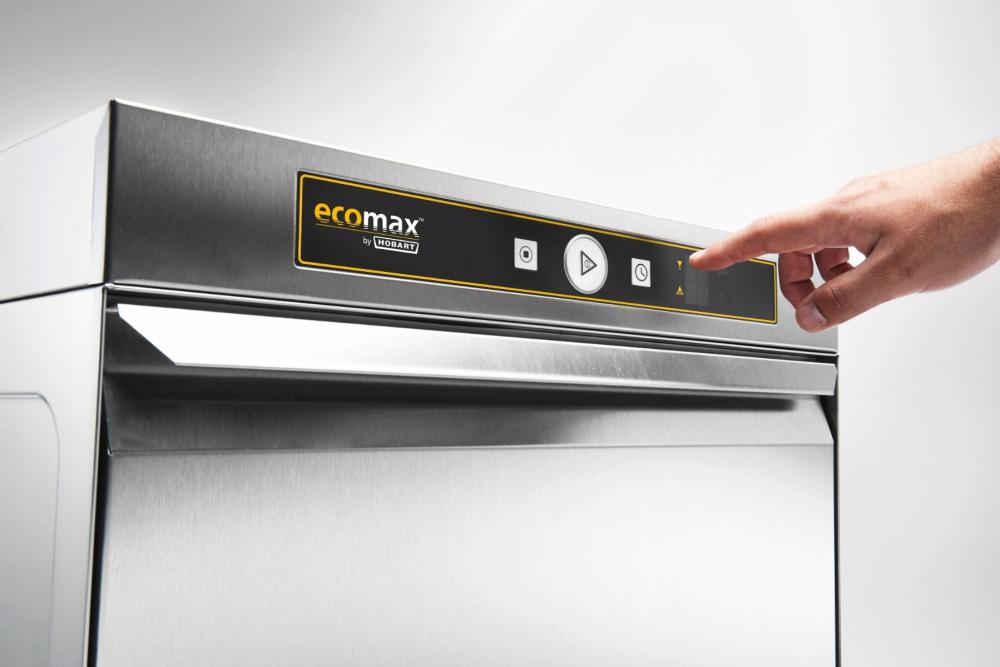
Hobart Ecomax
The Hobart Ecomax range covers undercounter dishwashers, glasswashers, and pass-through dishwashers designed for sites where daily throughput is consistent but not sustained at high volume. The range is characterised by straightforward operation, reliable German build quality, and steady performance that suits smaller professional kitchens. Thermostop rinse control ensures correct operating temperature is maintained at all times, and all models include a factory-fitted Class A air gap and integrated dosing units for detergent and rinse aid.
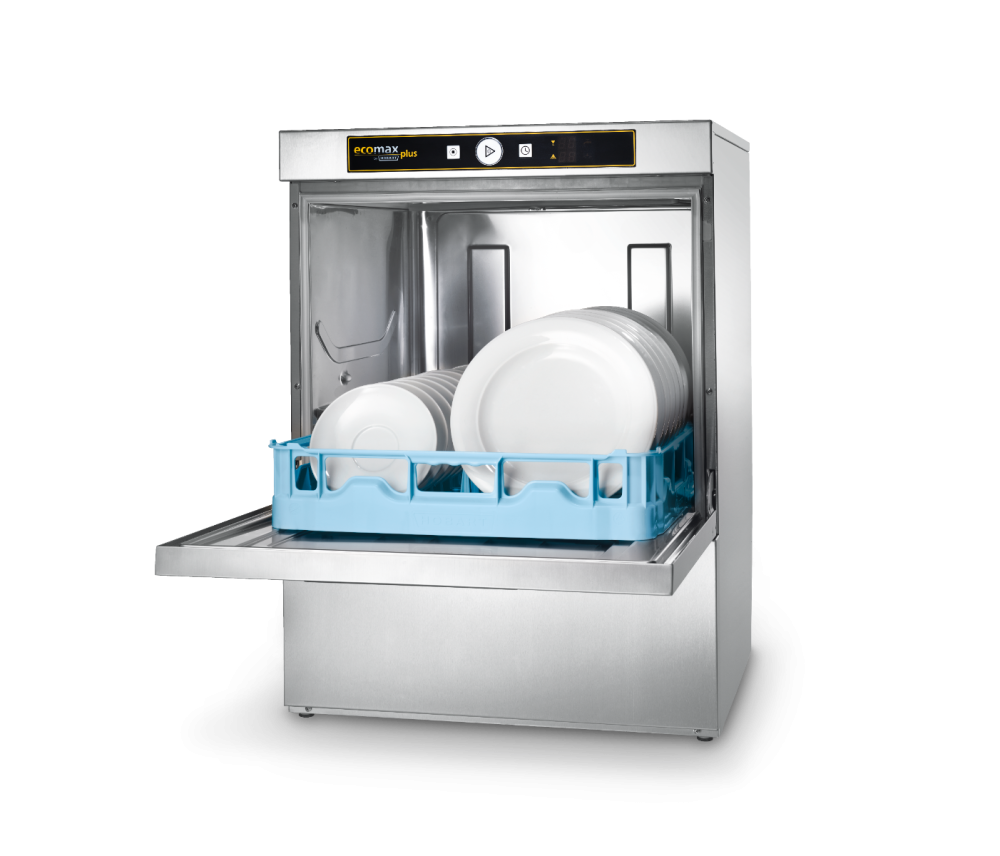
Hobart Ecomax Plus
The Hobart Ecomax Plus range is built for sites with heavier daily workloads and busier service patterns. The double-skinned insulated cabinet on the undercounter units reduces heat loss and maintains wash temperature with less energy. A smaller wash tank means faster heat-up and temperature recovery between cycles, reducing both energy and water consumption per rack. Uprated wash and rinse pumps deliver greater cleaning power at sustained throughput, and double racking capability on undercounter models allows two racks to be processed simultaneously where load types permit.
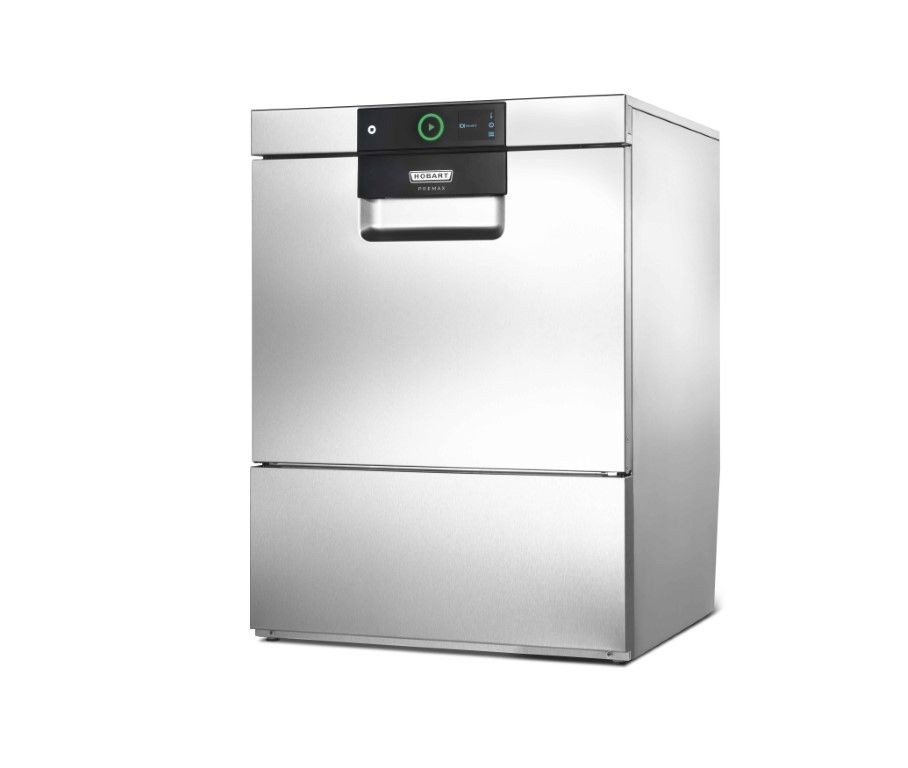
Hobart Profi and Premax
The Hobart Profi and Premax ranges represent the highest specification available in the Hobart commercial warewashing line-up. These machines are built for the most demanding professional environments including large hotel operations, contract catering, healthcare, and public sector sites running machines continuously through long service periods. The Premax undercounter dishwasher and glasswasher ranges include integrated drying as standard. SmartConnect remote diagnostics, GENIUS-X2 intelligent wash cycle management, and VISIOTRONIC-TOUCH control panels are available across Profi and Premax configurations. The Premax range also offers TOP-DRY condensation drying and VAPOSTOP2 steam reduction technology.
Public Sector and Charity Discounted Pricing is available on Hobart Profi and Premax equipment. If you are purchasing for a school, college, NHS facility, care home, or registered charity, contact the Ecomax Catering team to discuss preferential pricing before placing your order.
A Note on Glasswashers
If your primary requirement is cleaning glassware rather than mixed crockery, a dedicated commercial glasswasher is the correct specification rather than a dishwasher. Glasswashers operate at lower temperatures and use gentler wash pressures designed to protect glass clarity and avoid thermal shock.
Key factors when selecting a glasswasher include the basket size (350mm, 400mm, and 500mm configurations are common), the loading height and chamber height relative to the tallest glass in your collection, and cycle speed relative to your bar throughput. A glasswasher that cannot process glasses fast enough to keep pace with bar service creates the same bottleneck problem as an undersized dishwasher in a kitchen.
The Hobart range includes Ecomax, Ecomax Plus, and Profi and Premax glasswashers to match the same workload profiles as the dishwasher range.
Finance and Procurement Options
Hobart commercial warewashing equipment is available on a range of finance options to suit different procurement needs and budget structures.
- Interest free credit on 12 and 24 month plans is available on all Hobart equipment through Ecomax Catering
- Fixed monthly rental plans are available, covering the full warranty and removing the capital cost of purchase
- IwocaPay business credit is available at checkout for up to £30,000, subject to approval
- Public sector and charity organisations should contact the team directly for discounted pricing
Making the Right Choice
Choosing the right commercial dishwasher comes down to an honest assessment of five things: the throughput your site requires at peak, the machine type that suits your kitchen layout and service pattern, whether your water hardness requires softening, the power supply available at your site, and the specification tier that matches your daily operational demands.
The Hobart range covers every professional requirement from a compact undercounter machine for a small cafe to a continuous-flow flight-type machine for a large institution. The Ecomax Catering team is available to discuss your requirements and recommend the right machine for your specific site.
Frequently Asked Questions
Q: What size commercial dishwasher do I need?
A: The right size depends on your throughput at peak service. As a guide, sites serving up to 80 covers per sitting can typically be served by an undercounter dishwasher. Sites serving 80 to 200 covers will generally need a pass-through dishwasher. Above 200 covers or in continuous high-volume operations, a rack conveyor machine should be considered. Calculate your peak racks per hour requirement and build in a 20% buffer.
Q: Do I need a water softener with a commercial dishwasher?
A: If your site is in a hard or very hard water area, a water softener is strongly recommended. Around 60 per cent of the UK has hard water. Without a softener, limescale accumulates inside the machine, reducing performance, increasing energy consumption, and shortening machine life. Many Hobart models are available with an integrated softener as a factory-fitted option, denoted by the S suffix in the model name.
Q: What is the difference between a commercial dishwasher and a glasswasher?
A: A commercial glasswasher is designed specifically for cleaning glassware. It operates at lower temperatures and with gentler wash pressures than a dishwasher to protect glass clarity and avoid thermal shock. If your primary wash load is glassware, a dedicated glasswasher is the correct choice. If you need to wash a mix of crockery, cutlery, and glassware, a dishwasher is more appropriate.
Q: What is the difference between Hobart Ecomax and Ecomax Plus?
A: The Hobart Ecomax range is designed for sites with consistent but moderate daily throughput. The Ecomax Plus range is built for heavier daily workloads and features a double-skinned insulated cabinet (undercounters only), a smaller wash tank for faster heat-up and recovery, uprated wash and rinse pumps, and double racking capability on undercounter models. The two ranges serve different operational profiles rather than one being a direct replacement for the other.
Q: Can I get a commercial dishwasher on finance?
A: Yes. Hobart commercial dishwashers are available through Ecomax Catering on 12 and 24 month interest free credit plans. Fixed monthly rental plans are also available, which include a full warranty and remove the upfront capital cost. Public sector and charity organisations can contact the team for discounted pricing.
Q: What power supply does a commercial dishwasher need?
A: Undercounter dishwashers typically operate on a single phase 20-25amp supply with the option the downrate to a 13amp supply or even uprate them to a 3-phase supply. Pass-through machines typically operate on 3-phase (3x16amp) or single-phase (1x25amp) power supply. More powerful pass-through machines, rack conveyor machines, and flight-type machines require three-phase power. Always confirm the power requirements of your chosen machine against what is available at your site before purchasing.